Types of Cricket Balls: Which Ball Is Used Where and Why
Featured Gaming Portal
Ready to Play & Win Rewards?
Experience fast multiplier rounds, instant cashouts, and official certified fair play.
Provably FairInstant Cashouts
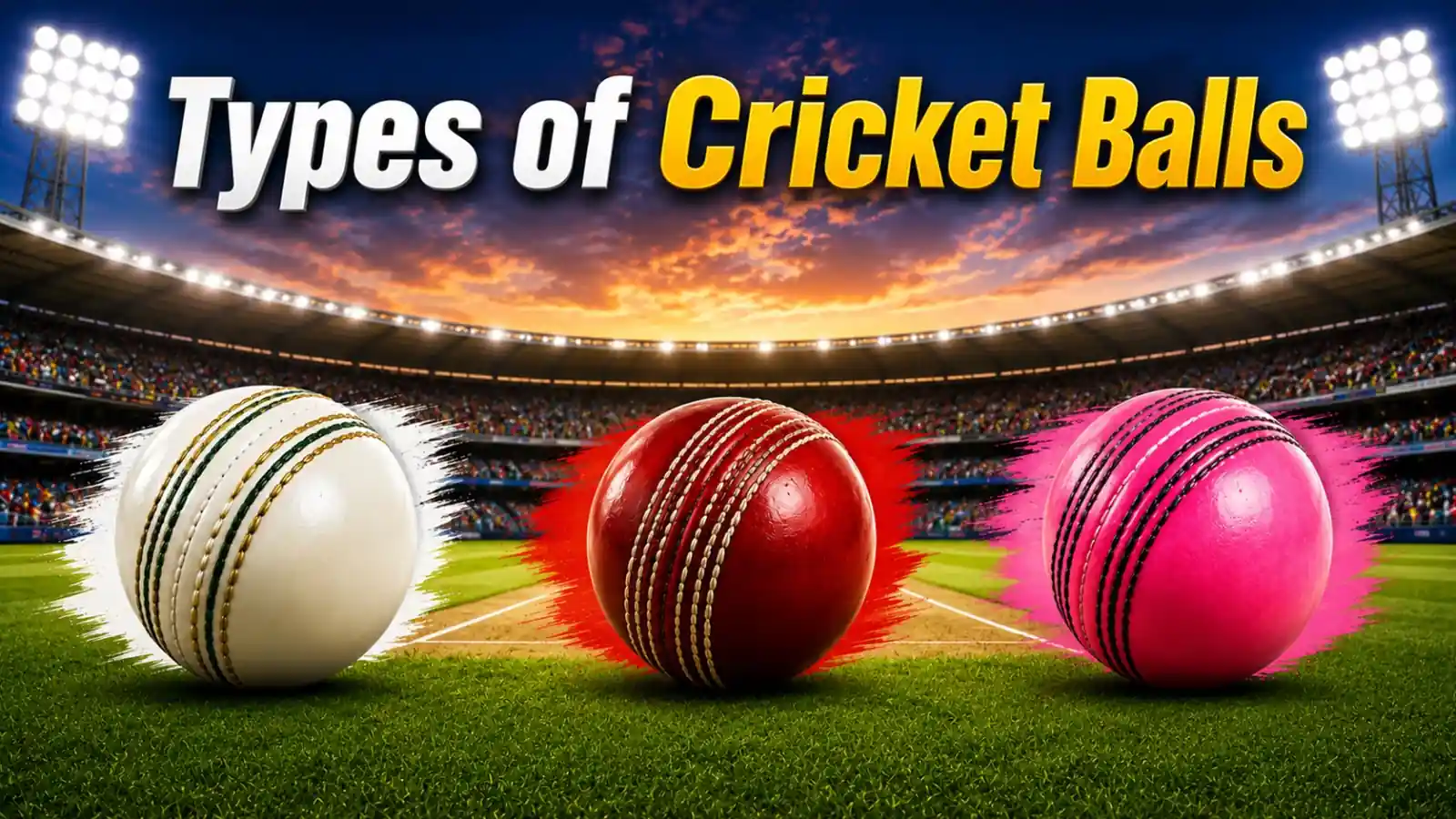
A cricket ball looks simple — just a red, white, or pink sphere — but it quietly decides how a match will unfold. There are three main types of cricket balls used in international cricket: the red ball (Test matches), the white ball (ODIs and T20Is), and the pink ball (Day-Night Tests).
Each one is made differently to suit its format, and three major brands — Kookaburra, SG, and Dukes — dominate international cricket, each with a distinct look, feel, and behaviour on the pitch.
How Cricket Ball Made? (Quick Basics)
Every ball starts with a cork core, sometimes layered with rubber for extra bounce. Tight windings of string or nylon are wrapped around that core to build hardness and shape.
Then comes the leather cover. Premium match balls use a four-piece construction — four quarters of leather stitched together — while cheaper practice balls often use a simpler two-piece design.
The two halves meet at the seam, a raised ridge of stitching that bowlers grip to generate swing and movement.
Finally, a coat of lacquer seals the surface, locks in the colour and preserves the shine that helps the ball swing early on.
Cricket Balls by Colour
The colour of a ball isn't a style choice — it comes down to visibility and durability for a specific format.
Getting your head around the red, white and pink cricket ball difference is the easiest way to make sense of the whole system.
Red Ball
The red ball is the traditional one, used in Test and first-class cricket played in daylight.
Built to last, it can survive long spells and only needs replacing after 80 overs. As it ages, the red leather slowly fades to a dull brown.
That's fine under the sun, but it turns nearly invisible under floodlights — the single limitation that opened the door to other colours.
White Ball
White balls belong to limited-overs cricket — ODIs and T20s, most of which are played under lights.
Against a dark evening sky, white simply shows up far better than red.
There's a trade-off, though.
The white ball tends to swing sharply in the opening overs, then scuffs, softens and gets grubby quicker than its red cousin — one big reason shorter formats manage the ball so carefully.
Pink Ball
The pink ball is the newest arrival, built specifically for day-night Tests. It carries extra lacquer so it holds its colour and shines across long twilight and floodlit sessions.
Here's a detail many fans miss: pink wasn't the first pick. Manufacturers trialled orange and yellow versions first, but batters kept losing them against the brown patches on the pitch, and camera crews struggled to track them under lights.
Pink offered the best balance of visibility for players, spectators and broadcasters — and that, in a nutshell, is why the pink ball is used in day-night Test matches today.
Cricket Balls by Brand: Dukes vs Kookaburra vs SG
There are three companies that carry out manufacturing operations at an international level.
The Dukes vs Kookaburra vs SG debate really comes down to how each one is stitched.
Dukes (England, West Indies, Ireland)
Dukes is an English brand, also used in the West Indies and Ireland. Every ball is fully hand-stitched, which gives it a proud, pronounced seam plus a light coat of grease that helps in England's damp, overcast conditions.
The payoff is swing — plenty of it, and for longer. A Dukes ball can keep talking to seamers well past the 30-over mark, which is exactly why English bowlers love it.
SG Test (India)
SG is India's ball of choice for home Tests. It's also hand-stitched, and its seam is arguably the most pronounced of the three, standing tall straight out of the box.
That prominent seam suits dry, abrasive Asian pitches. It roughens up nicely for reverse swing and gives spinners a raised seam to grip and rip — a perfect fit for India's spin-heavy game plan.
Kookaburra (Australia + Rest of the World)
Kookaburra, made in Australia, is the global default. Only its two inner rows of stitching are done by hand — the outer rows are machine-stitched — so the seam sits flatter and smooths out even more within about 30 overs.
That means a shorter swing window and less help off the surface, rewarding genuine pace over movement.
Crucially, it's the ball used in every white-ball international, so all ODIs and T20s worldwide are played with a Kookaburra.
Which Ball Is Used in Test, ODI and T20?
So which ball is used in Test, ODI and T20 cricket? The short version: format decides the colour, and a handful of rules decide how many balls come into play.
Format | Ball | Key Rule |
|---|---|---|
Test | Red (pink for day-night matches) | One ball per innings; a new ball is available after 80 overs |
ODI | White | Two new balls are used for overs 1–34, then one ball is selected for overs 35–50 |
T20 | White | One white ball per innings, with a spare available for replacement |
Why do ODIs need two balls? A single white ball simply can't stay visible or hold its shape across 100 overs, so a fresh ball is used from each end.
Since mid-2025, though, the fielding side picks just one of those two balls for the final 16 overs — a tweak designed to bring reverse swing back into the death overs.
Why Different Cricket Balls Are Used (The Real Reason)
Strip away the branding and it all comes down to context. The host country picks the ball that suits its own conditions — Dukes for England's swinging skies, SG for India's dry turners, Kookaburra for Australia's hard, bouncy decks.
Weather and pitch do the rest. A greasy Dukes swings under cloud cover; an abrading SG seam sets up reverse swing on rough Indian surfaces.
Format then layers on top, deciding the colour and how long a ball stays in play.
Need proof that conditions rule everything? English county cricket spent three seasons trialling the Kookaburra, then scrapped it and returned fully to the Dukes ball for the 2026 season — because the ball has to match the environment, not the other way round.
Standard Cricket Ball Specifications
Whatever the colour or brand, every match ball must meet the same legal limits.
The official cricket ball weight and specifications are set by the MCC's Laws of Cricket and enforced worldwide by the ICC.
Category | Weight | Circumference |
|---|---|---|
Men’s | 155.9–163 g (5.5–5.75 oz) | 22.4–22.9 cm (8.81–9 in) |
Women’s | 140–151 g (4.94–5.31 oz) | 21.0–22.5 cm (8.25–8.88 in) |
A few grams may sound trivial, but they change how the ball swings, bounces and carries — which is why anything outside these ranges is ruled unfit for play.
FAQ Section
Frequently Asked Questions
Find answers to common questions about gameplay, rules, strategies, and fairness.
Not really. All three share the same cork core, winding and leather build. The difference lies in the dye and the amount of lacquer, which changes how each one wears and swings.