Pilot Chicken vs Other Crash Games: How It Really Compares
Featured Gaming Portal
Ready to Play & Win Rewards?
Experience fast multiplier rounds, instant cashouts, and official certified fair play.
Provably FairInstant Cashouts
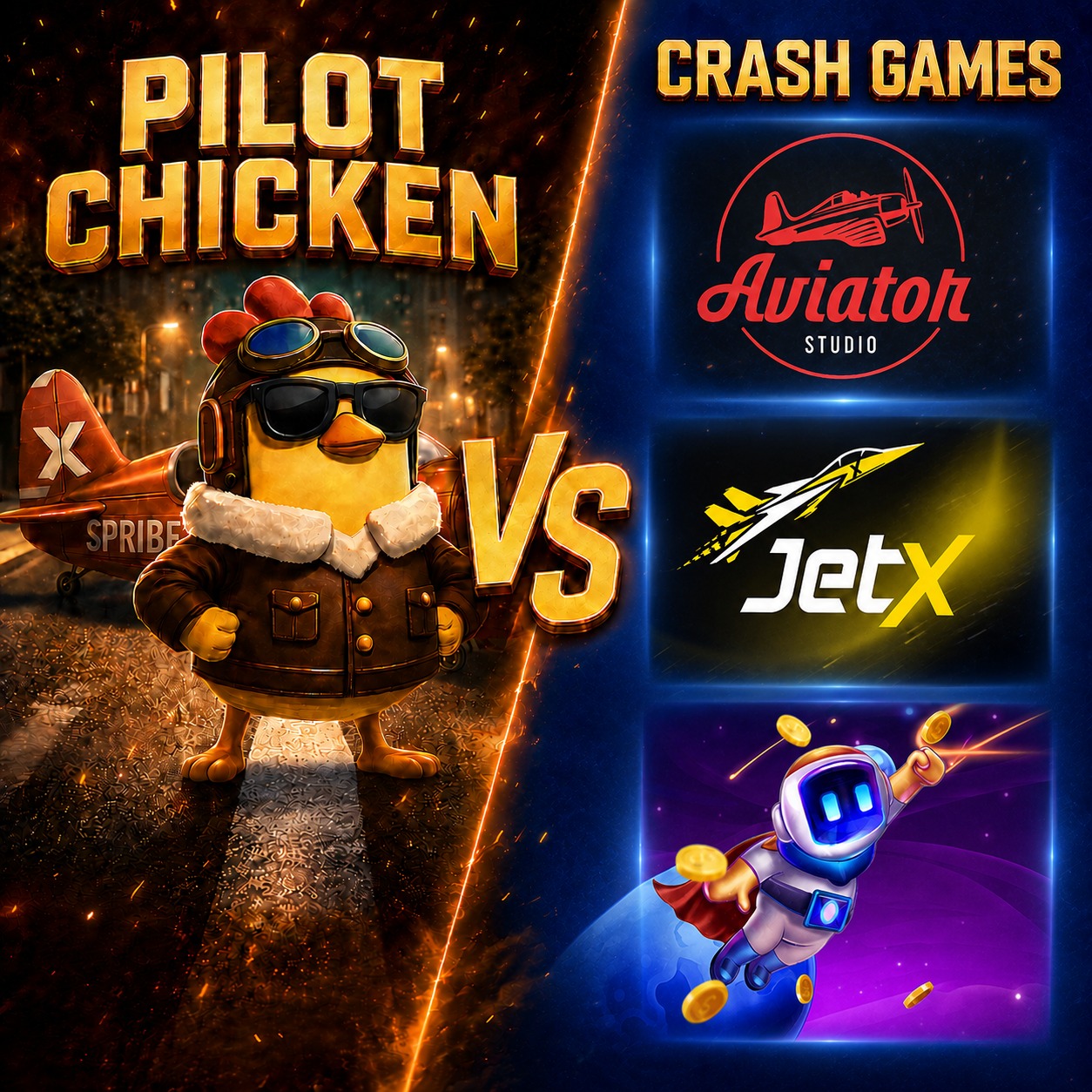
Crash games all share the same basic promise: a multiplier climbs, you decide when to walk away, and if you wait too long, it's gone. But underneath that shared formula, the mechanics, risk profiles, and pacing can differ quite a lot from one title to the next. If you've spent time with Aviator, JetX, or Spaceman and are now looking at Pilot Chicken, it's worth understanding exactly where the differences lie before you put a stake down.
This guide lines Pilot Chicken up against the genre's biggest names across the things that actually affect how a session feels and plays out: return to player, volatility control, multiplier ceilings, and pacing.
A Quick Recap: How Pilot Chicken Works
Pilot Chicken, developed by Spribe (the studio behind Aviator), swaps the usual rising line or ascending plane for a chicken named Pily making her way across a runway full of oncoming aircraft. Every step forward pushes the multiplier a little higher, and every step also brings the next plane a little closer. You decide when to bank the multiplier and stop, and if a plane catches Pily first, the round ends with nothing.
The headline number is a theoretical multiplier ceiling of 1,000,000x, though individual bets are capped at a lower real-money limit. The game runs on a standard return to player figure of 97%, which puts it right in line with the rest of the genre rather than standing out as unusually generous or unusually tight.
Like the other titles in this comparison, outcomes are generated using a random number generator (RNG) and verified through a provably fair system, so every round's result can be checked independently rather than taken on trust. Bet sizing typically runs from small stakes up to higher limits depending on the platform, and most versions support auto cash-out settings that lock in a chosen multiplier automatically, alongside the manual option of cashing out by hand as the round plays.
Feature | Pilot Chicken | Aviator | JetX | Spaceman |
|---|---|---|---|---|
Developer | Spribe | Spribe | SmartSoft Gaming | Pragmatic Play |
RTP | 97% | 97% | 96.2%–98.9% (casino-dependent) | 96.5% |
Maximum Multiplier | Up to 1,000,000x (theoretical) | Around 100x–10,000x (depending on the source) | Up to 25,000x | Up to 5,000x |
Risk/Volatility Control | Three selectable modes: Easy, Medium and Hard | Fixed volatility | Adapts to the betting pattern | Fixed volatility |
Cash-Out Style | Single full cash-out | Dual bet slots | Triple multi-bet | Half cash-out option |
Visual Theme | Chicken crossing a runway | Rising plane | Ascending jet | Astronaut drifting upward |
Round Length | Short and step-based | Short | Short | Short |
Provably Fair | Yes | Yes | Yes | Yes |
Auto Cash-Out | Yes | Yes | Yes | Yes |
A few things stand out here. Pilot Chicken's three-mode risk system is a genuine structural difference rather than a cosmetic one: Easy mode caps out lower but stretches the run over more steps, while Hard mode opens up the full multiplier range at the cost of a much shorter path to a crash. That's a different kind of control to what you get with JetX's multi-bet approach or Spaceman's half cash-out, and it changes how you'd actually plan a session.
Where Pilot Chicken Pulls Ahead
Session-level risk control. Rather than relying purely on when you cash out, Pilot Chicken lets you set your risk appetite before the round even starts. Easy mode suits players who want longer, steadier sessions, while Hard mode is built for anyone chasing the bigger multipliers and accepting the shorter odds that come with it. Aviator and Spaceman don't offer this kind of built-in adjustment; your only lever is timing.
Visual clarity of progress. Because the chicken moves in distinct steps rather than a continuously climbing number or line, it's easier to track exactly how far into a round you are and how much runway (literally) is left. Some players find this more intuitive than watching an abstract multiplier tick upward.
A fresh take on a familiar loop. Aviator, JetX, and Spaceman all lean on ascending or flying visuals. Pilot Chicken's road-crossing theme doesn't change the underlying mathematics, but it does mean the genre hasn't gone stale if you've already logged a lot of hours on the other three.
Trying it in demo mode first. Because Pilot Chicken's risk modes behave so differently from one another, running a few free rounds in demo mode before betting real money is a practical way to see how Easy, Medium, and Hard actually feel in practice, without touching your stake limits.
Where the Others Still Have the Edge
JetX's ceiling is higher. With a published maximum multiplier of 25,000x against Pilot Chicken's real-money cap, JetX theoretically offers more room to run if you're specifically chasing a large multiplier and don't mind the volatility that comes with it.
Aviator's dual-bet system suits a particular style. Being able to place two simultaneous bets — one for a quick, low-multiplier cash-out and one held for longer — gives Aviator players a built-in way to hedge within a single round. Pilot Chicken's single cash-out is simpler, but it doesn't replicate that specific mechanic.
Spaceman's half cash-out reduces all-or-nothing pressure. Being able to bank half your position and let the rest ride is a genuinely different risk tool to anything in Pilot Chicken, JetX, or Aviator, and some players prefer it precisely because it softens the binary win-or-lose nature of a round.
RTP: How Much Does the Difference Actually Matter?
On paper, Pilot Chicken's 97% RTP sits close to Aviator's 97% and a touch above Spaceman's 96.5%. JetX is the outlier, with a wider published range that depends heavily on the operator's specific configuration.
It's worth being clear that these are theoretical, long-run figures calculated over a very large number of rounds. They describe the mathematical design of the game rather than what any individual session will look like, and a difference of a percentage point or two won't be noticeable over a short sitting. If RTP is something you want to weigh up in detail, our RTP & Volatility Explained guide breaks down what the figure does and doesn't tell you.
Which One Fits Your Play Style?
If you like a defined risk setting before you start — Pilot Chicken's three-mode system is the most direct way to dial in your approach up front.
If you want the highest theoretical multiplier ceiling — JetX's published range goes further than Pilot Chicken's real-money cap.
If you like hedging within a single round — Aviator's dual-bet structure offers that in a way none of the others quite replicate.
If you'd rather bank part of a win and let the rest ride — Spaceman's half cash-out is built specifically for that.
None of these are objectively "better" in a way that guarantees an outcome — they're different tools for different preferences, and the house edge built into each game means no amount of style-matching changes the underlying odds.
Take Time to Think
Crash games move quickly, and it's easy to lose track of time or spend once the multiplier starts climbing. Whichever game you choose, it's worth setting a budget and a time limit before you start, and stepping away once you hit either. If gambling stops feeling like entertainment, support is available through GamCare and BeGambleAware.
FAQ Section
Frequently Asked Questions
Find answers to common questions about gameplay, rules, strategies, and fairness.
No. Both are made by Spribe and share the same basic crash mechanic, but Pilot Chicken uses a step-based road-crossing format with selectable risk modes, while Aviator uses a continuously climbing multiplier with a dual-bet system.